서울 만리동 산꼭대기 예술인마을에서 펼쳐지는 다큐 연극 <아임언아티스트>
The documentary play “I’m an artist”, which is played in the Mallidong Artist Cooperative House
Son Joon-hyun _<Hankyoreh> Popular Culture Team journalist
# 104m Artists’ House on the mountaintop

When you take the Blue Bus 163 · 261 · 463 · 604 and Green Bus 8001 and get off at Malli-dong Hill Station, you can see a lot of signs ‘wanted-a temporary worker for Taylor’. Continuing to climb the hill road, you can see the advertisement for the sewing factory. There was a song ‘Red flower, yellow flower, every flower blossom, sewing machine work for 24 hours’.
“There is a shop that sells sewing machines for 24 hours, a shop that specializes in selling only silk, and a large sewing company called ‘Lehobot.’ Eunseo Yi, who is the director of the theater <I’m an artist>, performed like a tourist guide with a hand microphone. <I’m an Artist> was performed at Malli-dong Artist House in Seoul from January 14 to 18. This is a part of the play that dozens of audiences were guided to the villages from the bus station to the house.
On the right side of the road, there were 1970s old houses and shops, and there were 25-stories huge new apartment buildings on the left side. After we went up a steep, dense wooden staircase, and we were out of the breath, the top of the 104m Bonghaksan hill appears. According to the legend, this is a place for the students of an old school near the hill, who struggled for mastery. Listening to the legend, you raised your head to heaven, you could see Mallidong Artists Cooperative (M.A.Coop) house. On the top of the hill, the audiences from the Seoul Station, Gongdeok Station, and Chong Jung-ro station, gathered and the winds of January smashed the audiences’ ears and face. “Welcome to M.A.Coop, welcome the audience!”
# “Parenting Than Theater, Am I an Artist?”
The artist’s house is a ‘daldongne'(poor hillside village) that has to go up the road of suffering for 15 to 20 minutes every day, though the city of Seoul is visible at a glance. In 2013, the artists made a form of union and started moving in 2015. Of 29 houses, 66 residents now live in 27 houses. The building consists of 5 floors and every house is less than 60 square meters. There are 9 studio-type houses, 10 houses with 2 rooms and 3 rooms. People can live for up to 20 years at 80% of the surrounding charter price. The tenant must work in the field of art prescribed by the Law for the Promotion of Culture and Arts such as literature, art, music, dance, drama, film, entertainment, Korean traditional music, photography, architecture, language, and publishing. If you have too much money, you are not qualified. If you have too little, you can not rent.
The director was inspired to see the artists’ neighbors but she also felt deep discomfort. When she was selected one of the candidates in 45 people for 29 house, she had to prove that “I am an artist more suitable for the house of artists than the competitors”. She spent more time in childcare than in a theater. She asked by herself “Oh, what am I doing now? Am I really an artist?” She started talking to her artist neighbors at the playground with children.
So, the director explains, “I am afraid of childbirths and career breaks in an artist’s house as a woman, and I am planning to perform with other mom artists <I am an artist>.” Based on the actual story, she co-created it through interviews and discussions. The idea of the Jeongyun Gu who is a writer and living in the artists’ house 2nd floor was the first departure. And Eunseo Yi opened the Forum in November 2016 to form a big frame of theater direction. In broad terms, it falls under the category of documentary theater, but the director stipulates that it is a “narrative-based drama.” It means that a very private story shows how it becomes a play in a documentary and becomes a documentary in a play again.
The title is ambiguous. I am ‘an’ artist. (I am a mere artist) and ‘an artist-un artist’ (I am not an artist). On the other hand, it expresses anxiety as “frozen artist” (I am 언(an-pronounces frozen in Korean) artist).
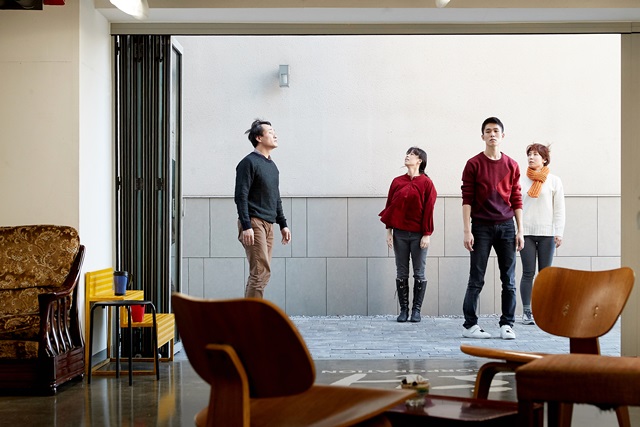
In the last scene, the actors open the glass door and go out. It seems to be an attempt to break the prescribed framework. In the last scene, the actors open the glass door and go out. It seems to be an attempt to break the prescribed framework.
#The relationship between life and art is in progress
Performances began in the community room on the first floor of the artist’s house. Lee So Young(dancer) introduced an anecdote that experienced the slump and teaches simple dance to audiences. Kim Seung-eon(actor) introduces the psychological burden experienced by 45 preliminary residents who selected as double of the occupant of real residents. Kim Soo-jin(actress) plays the role of the tenant. Sun see Lee (dancer) asks the audience what is the essence of dance, not technique.
The highlight was the ‘Mayfly and wing’ that decorate the end of the play. Lee So Young’s writing and the choreography of Lee Sun see are added, and actors read and dance.
“I live a day. I do not blame anyone or I would not be sad. (…) I struggled to keep the wings. I could not move my wings by myself. It hurt. It is over. I took off my wings. I had to take it off. An empty body. Even if I am born again, I will not give up my dreams. Wings without wings moved every time I breathe. It is moved with my own energy. Time meets the fold. ”
After the childbirth, a ‘wing’ as a dancer is dim and ’empty body’ is left on the Lee so young’s life. The artist’s wings have been broken, but dreams remain dead and still wriggle. Does ‘Time to Fold’ meet the time before and after childbirth to promote new development? The life of women artists who have lost their careers reminds me of a verse of Yi Sang’s ‘wing’, “fly, fly again.”.
The actors opened the folding glass door and left the artist ‘s house. The wind occupied the house. It was refreshing that creeps.
It seems to be a process of going out by breaking the framework of the stereotype of the artist who is defined by the artists’ house suppliers Seoul City and the Seoul Housing and Urban Development Corporation (SH) and the artists themselves. The top-of-the-mountain artists’ house is a space that goes inside and out of the house, inside and outside the arts. How life and art in the city are related, how life and art can go side by side, and how to relate to the questions of artist artists are still ‘progressive’.
<I’m An Artist> is a work selected as a New Stage by the Seoul Foundation for Arts and Culture. The director Eunseo Yi recently met with the “Blacklist situation” and said, “I want to work on social issues.”

 오인제오 이Eunseo Yi